Each dot is a unit on a drifting graph. It fires once r of its neighbours have fired at it within a short window, then rests. The slate squares are inhibitory: each of their spikes cancels half of an excitatory one. A cascade either fizzles or sweeps the graph. This is the model from my PhD work on bootstrap percolation with inhibition.
Click to ignite. Hold to widen the ignition front.
Hafsteinn
Einarsson
Associate Professor and Head of Faculty, University of Iceland
Principal Scientist, Amgen deCODE

I lead a research group working on language technology for Icelandic and Faroese, with projects in computer vision for the natural sciences, clinical AI and human genetics. I also talk about AI in public a lot, most recently in a seven-part video series.
News
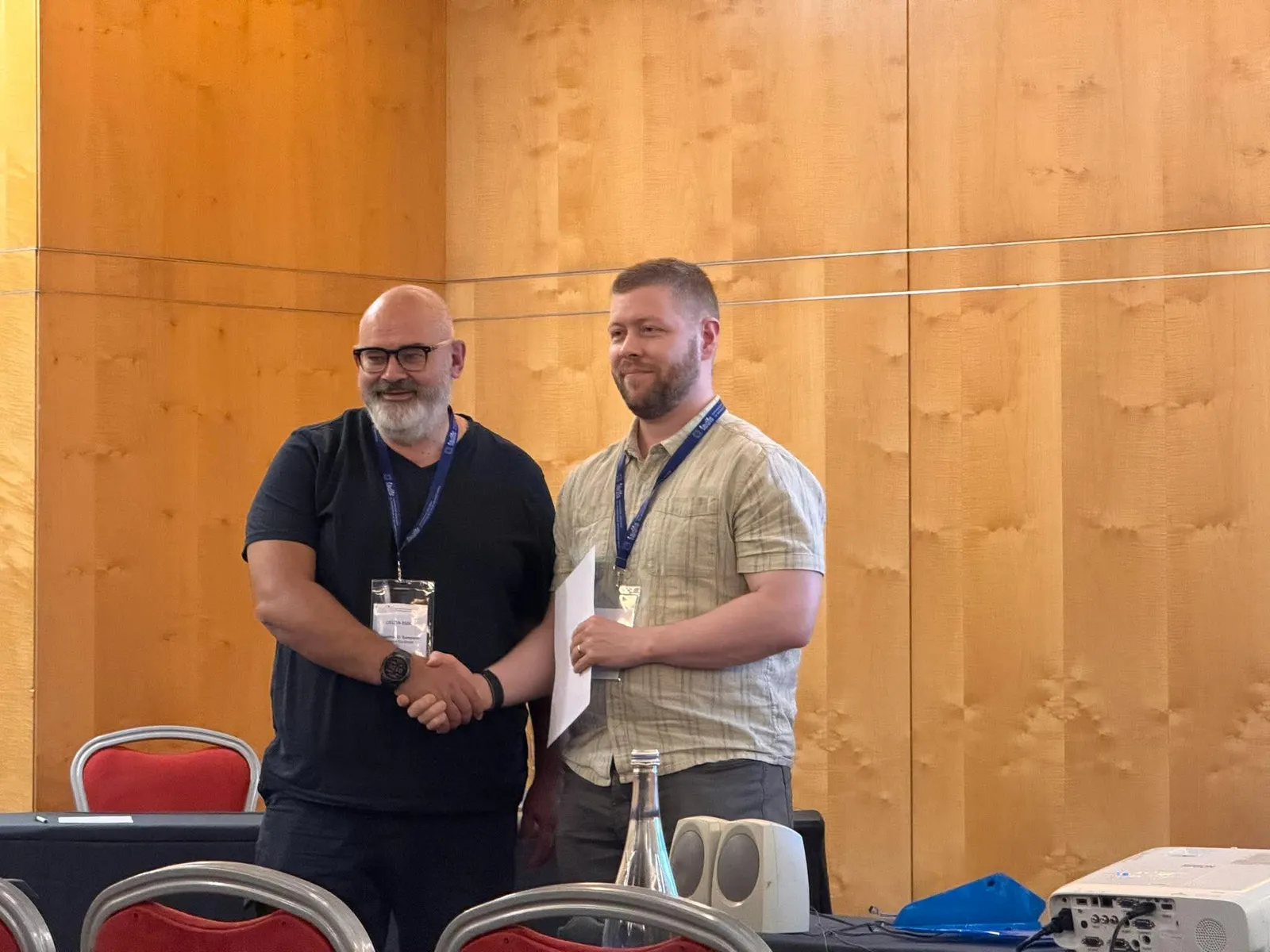
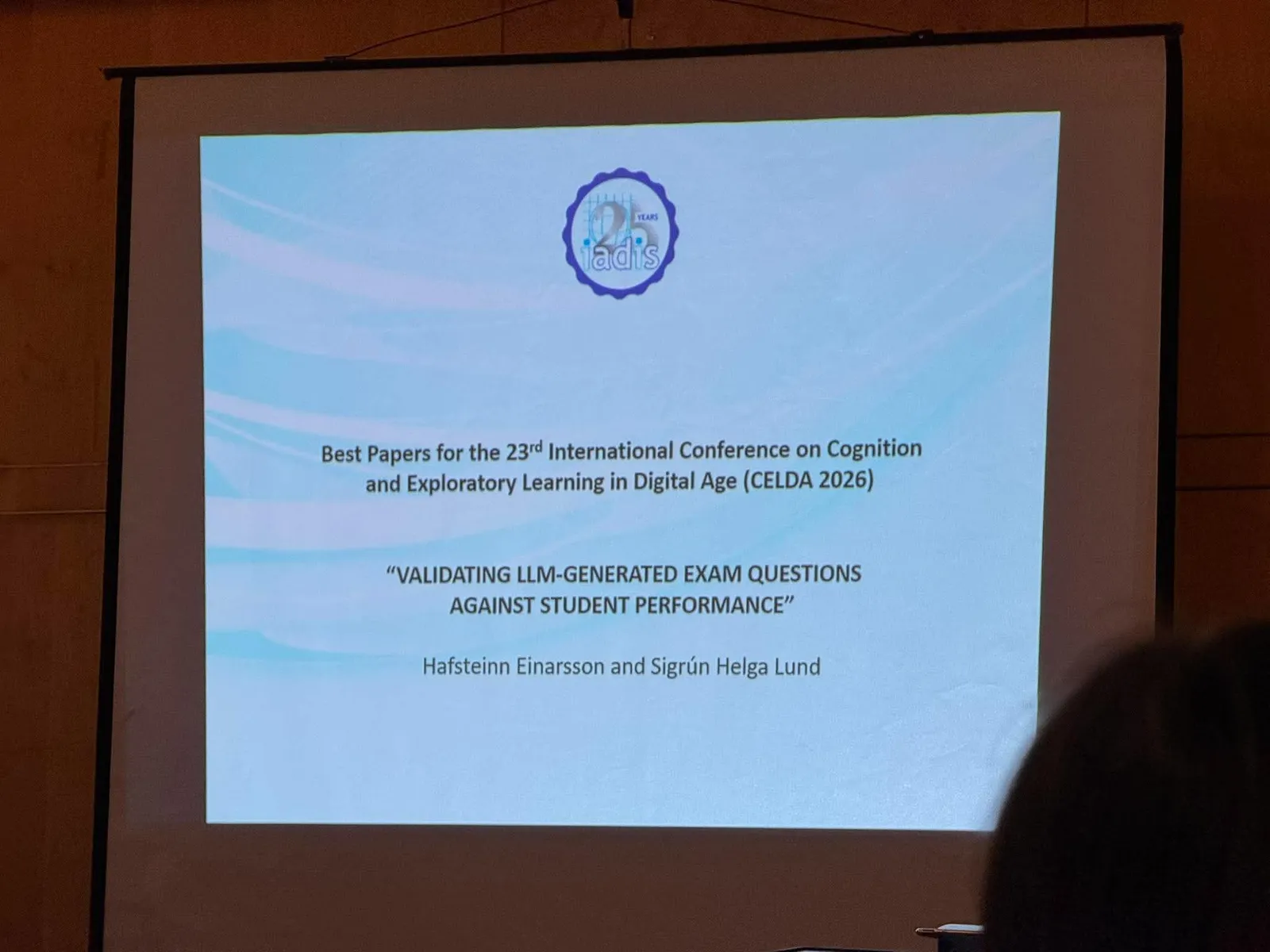
Selected publications
NLP for Icelandic & Germanic MazeEval: a benchmark for testing sequential decision-making in language models Einarsson, H. · Proceedings of the fifteenth language resources and evaluation conference (LREC 2026) · 2026
MazeEval is a benchmark for testing sequential decision-making in language models through navigation tasks in procedurally generated mazes. The setup probes whether models can maintain a coherent internal map across multiple turns of interaction rather than relying on local pattern matching. Single-author paper published at LREC 2026.
- DOI →
- arXiv →
- PDF →
@inproceedings{einarsson2025mazeeval,
  title={{MazeEval}: A Benchmark for Testing Sequential Decision-Making in Language Models},
  author={Einarsson, Hafsteinn},
  booktitle={Proceedings of the Fifteenth Language Resources and Evaluation Conference (LREC 2026)},
  pages={407--418},
  year={2026}
}
NLP for Icelandic & Germanic Curated retrieval versus open web search in public AI information services: a coverage-trust trade-off Einarsson, H., Einarsson, H. B., Ólafsson, J. G., Þorsteinsson, J. G. · arXiv preprint arXiv:2607.05217 · 2026
A pre-launch expert evaluation of Evrópuvefur, a government-funded University of Iceland service that answers questions about the European Union, conducted as Iceland prepared for its August 2026 referendum on resuming EU accession talks. Five domain experts produced 551 evaluations of 449 AI-generated answers, comparing a curated local corpus (RAG) against open web search: web search answered more questions but flagged an untrustworthy or irrelevant source in 35% of answers, while the curated corpus was trustworthy yet limited in coverage. Argues that source trustworthiness is a measurable but largely invisible dimension of information quality in public AI services. First-author arXiv preprint.
- arXiv →
@article{einarsson2026curated,
  title={Curated retrieval versus open web search in public {AI} information services: a coverage-trust trade-off},
  author={Einarsson, Hafsteinn and Einarsson, Hafsteinn Birgir and {\'O}lafsson, J{\'o}n Gunnar and {\TH}orsteinsson, J{\'o}n Gunnar},
  journal={arXiv preprint arXiv:2607.05217},
  year={2026}
}
Machine Learning · Natural Sciences Temporal aggregation of vision-language features for high-accuracy fish classification in automated monitoring Silva Martins, J. R., Bárðarson, H., Guðbrandsson, J., Einarsson, H. · Ecological Informatics · 2025
Aggregates temporal vision-language features from underwater video to classify fish species in automated monitoring streams, combining per-frame embeddings with temporal pooling to handle the noise and occlusion that limit frame-by-frame classifiers in deployed systems. Published in Ecological Informatics (2025) as part of the lab's ongoing computer-vision work with the Marine and Freshwater Research Institute.
- DOI →
@article{da2025temporal,
  title={Temporal aggregation of vision-language features for high-accuracy fish classification in automated monitoring},
  author={da Silva Martins, Jo{\~a}o Rodrigo and B{\'a}r{\dh}arson, Hlynur and Gu{\dh}brandsson, J{\'o}hannes and Einarsson, Hafsteinn},
  journal={Ecological Informatics},
  volume={92},
  pages={103462},
  year={2025},
  doi={10.1016/j.ecoinf.2025.103462},
  publisher={Elsevier}
}
Video series

Could AI destroy us?
Gæti gervigreindin grandað okkur?
It is hard to picture how AI could actually harm us, so I made seven short films that each retell one serious argument, from an experiment in which an AI tried to blackmail an executive to a future where we lose control without noticing. I wrote the scripts. The images, music and my voice are generated with AI.
- The assistant that read the wrong email
- The AI that started a war it never fought
- Sixteen hours overnight
- The soldiers who never say no
- The world where bombs were easy
- Thirty-six minutes
- Not with a bang